By Peter J. McCormick
ISBN-10: 1442606398
ISBN-13: 9781442606395
ISBN-10: 1442608331
ISBN-13: 9781442608337
The finish of the constitution Revolution explores the Canadian constitution of Rights and Freedoms, starting with a normal old heritage, by way of a survey of the numerous adjustments led to as constitution judgements have been made. The publication addresses a sequence of particular circumstances made sooner than the Dickson, Lamer, and McLachlin Courts, after which offers empirical information to help the argument that the constitution revolution has ended. The very best court docket has with out query turn into "a nationwide establishment of the 1st order," yet although the constitution is a huge a part of why this has occurred, it isn't constitution judgements that might show off the workout of this strength within the future.
Read Online or Download The End of the Charter Revolution: Looking Back from the New Normal PDF
Similar civil rights & liberties books
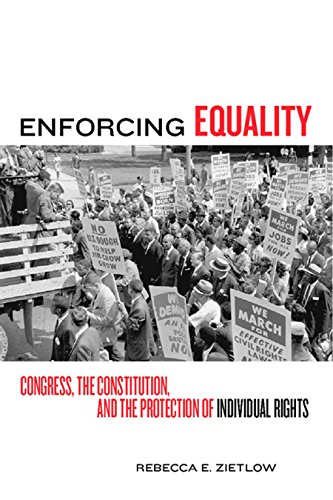
Enforcing Equality: Congress, the Constitution, and the - download pdf or read online
In imposing Equality, Rebecca E. Zietlow assesses Congress's ancient position in studying the structure and maintaining the person rights of electorate, provocatively hard traditional knowledge that courts, no longer legislatures, are most fitted for this function. in particular concentrating on what she calls “rights of belonging”—a set of optimistic entitlements which are essential to be certain inclusion, participation, and equivalent club in different communities—Zietlow examines 3 historic eras: Reconstruction, the hot Deal period, and Civil Rights period of the Nineteen Sixties.
Download PDF by Alexandre Lefebvre: Human Rights as a Way of Life: On Bergson's Political
The paintings of Henri Bergson, the key French thinker of the early 20th century, isn't frequently explored for its political dimensions. certainly, Bergson is better identified for his writings on time, evolution, and creativity. This booklet concentrates as a substitute on his political philosophy—and in particular on his past due masterpiece, the 2 resources of Morality and Religion—from which Alexandre Lefebvre develops an unique method of human rights.
Edward S. Mihalkanin,Robert F. Gorman's Historical Dictionary of Human Rights and Humanitarian PDF
Whereas the belief of human rights and humanitarian counsel has historic roots_evidence could be obvious in such examples because the Ten Commandments, the Bhagavad Gita, and the lessons of Confucius and Socrates_it wasn't till the 1800s that the 1st glossy humanitarian and human rights organisations got here to be.
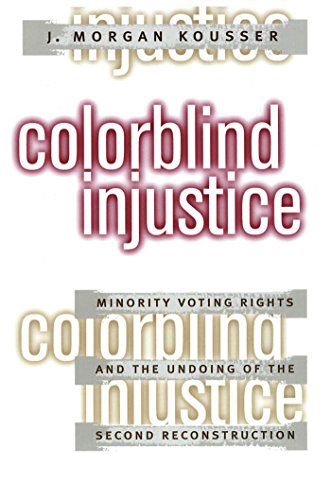
Read e-book online Colorblind Injustice: Minority Voting Rights and the Undoing PDF
Difficult fresh traits either in historic scholarship and in splendid court docket judgements on civil rights, J. Morgan Kousser criticizes the Court's "postmodern equivalent defense" and demonstrates that legislative and judicial historical past nonetheless subject for public coverage. providing an unique interpretation of the failure of the 1st Reconstruction (after the Civil battle) via evaluating it with the relative good fortune of the second one (after international battle II), Kousser argues that associations and institutional rules--not customs, principles, attitudes, tradition, or person behavior--have been the first forces shaping American race relatives through the country's background.
- Scandalous Economics: Gender and the Politics of Financial Crises (Oxford Studies in Gender and International Relations)
- Caring for America: Home Health Workers in the Shadow of the Welfare State
- Human Rights in Cuba, El Salvador and Nicaragua: A Sociological Perspective on Human Rights Abuse (Studies in International Relations)
- Puerto Rican Citizen: History and Political Identity in Twentieth-Century New York City (Historical Studies of Urban America)
- The New Jim Crow
- Out of the Shadows, Into the Streets!: Transmedia Organizing and the Immigrant Rights Movement (MIT Press)
Extra info for The End of the Charter Revolution: Looking Back from the New Normal
Sample text
The End of the Charter Revolution: Looking Back from the New Normal by Peter J. McCormick
by John
4.5